1
/
of
4
DNRC Montana Conservation Seedling Nursery
Big Sage
Big Sage
Regular price
$48.00 USD
Regular price
Sale price
$48.00 USD
Unit price
/
per
Out of stock
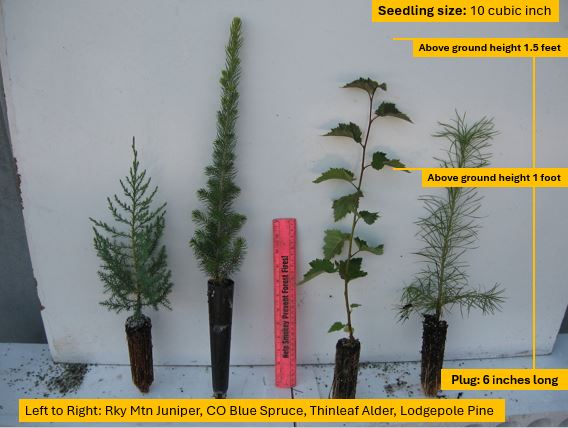
*ORDERING QUANTITIES - our seedlings are sold in bulk*
10 - 27 cubic inch (ci) seedlings are sold in bundles of 24 (1 unit = 24 seedlings)
100 & 175 cubic inch (ci) seedlings are sold in bundles of 9 (1 unit = 9 seedlings)
-----------------------
Artemisia tridentata
Natural Habitat: Arid and semi-arid cold deserts, sagebrush-steppe, open slopes, plains, foothills from ~1,500 to 10,000 ft
Foliage / Flowers: Evergreen shrub with silvery‑gray, wedge-shaped ½–1¼ in leaves (usually tridentate tips); late summer to early fall displays small yellow tubular flower clusters; seed-like achenes
Light Requirements: Full sun
Growth Rate: Slow to moderate; reaches mature size (~2–10 ft) in ~8 years
20‑year Height: 6–10 ft, sometimes up to 15 ft in deep soils
Elevation Range: ~1,500–10,000 ft
Cold Hardiness: USDA Zones 2–9; hardy to –40 °F
Fire Tolerance: Low, highly flammable with volatile oils; typically top‑killed by fire and does not resprout; regenerates only from seed bank
Wind Tolerance: High, thrives in exposed, windy environments
Soil Preference: Deep, well‑drained sandy to silt loams; tolerates basic/alkaline soils; avoids waterlogged sites
Alkali / Saline Soil Tolerance: Moderate, tolerates alkaline soils, low saline tolerance
Life Span: Long-lived; often >100 years, typically 50–100+ years
Minimum Annual Precip: 10–18 in (250–450 mm); thrives in 10–30 in environments
Drought Tolerance: Very high once established; deep taproots and fine lateral roots capture moisture
Windbreak Spacing: For restoration, space shrubs ~6–10 ft apart to form dense stands
Potential Pests / Disease: Generally resilient; may see aphids, spider mites, caterpillars, powdery mildew, rust fungi
Deer Resistance: High, bitter foliage with volatile oils makes it unpalatable to deer and livestock
Wildlife Value: Critical habitat and forage for many species
- Sage grouse (nesting, cover, winter forage)
- Pronghorn, mule deer, and elk (winter browse)
- Small mammals and birds (cover and food)
- Pollinators utilize late-season flowers and associated insects